Case study
CareerCraft
A job search platform for the German market: one career profile becomes every CV, and each version is checked the way an applicant tracking system reads it.
- Role
- Sole developer
- Year
- 2026, in development
- Source
- Public, MIT licence
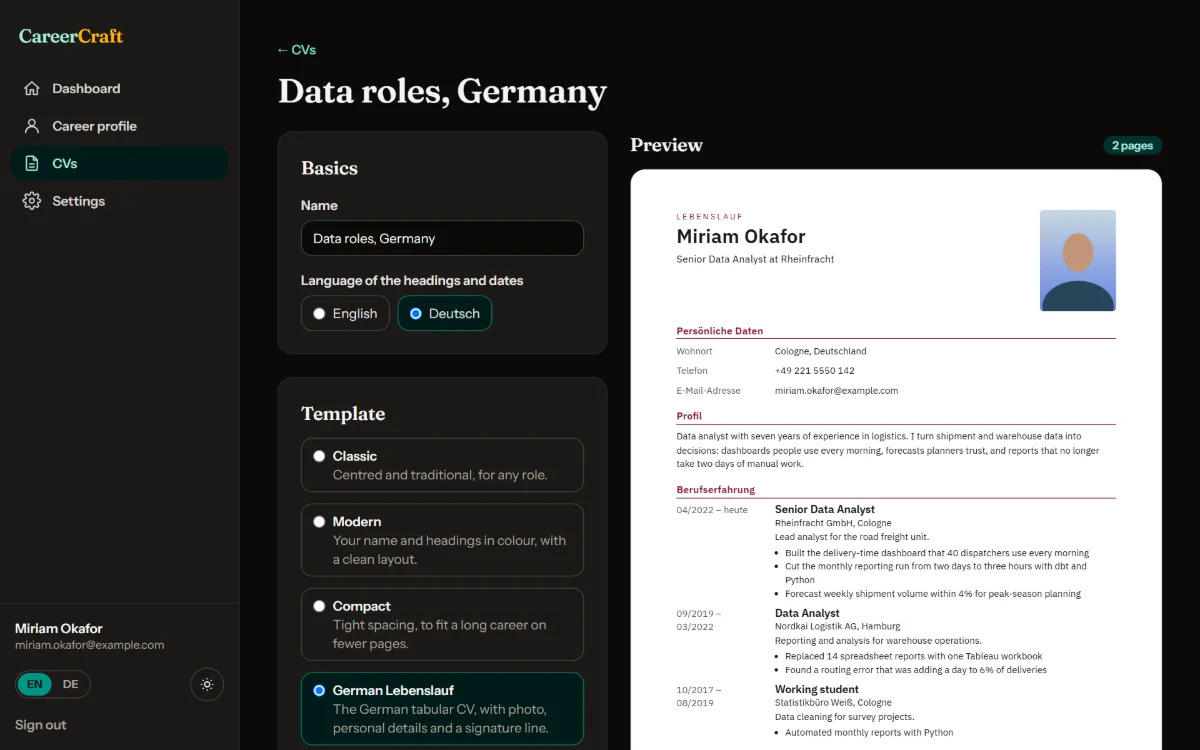
- CV templates, one of them the German tabular Lebenslauf
- 4
- AI providers to choose from, one free and local
- 3
- languages on every screen and in every email
- 2
- CV files kept after an import
- 0
01
One career, many applications
Applying for jobs means rewriting the same career into a slightly different CV each time, and never being sure what an employer's software makes of the PDF. In Germany there is a second format to maintain as well: the tabular Lebenslauf with photo, place, date and signature.
CareerCraft keeps one structured career profile and builds every CV from it. It is in development: the foundation, accounts, the profile, CV import, the CV builder and the AI layer are built. Cover letters, job matching and application tracking come next.
Stack
- Laravel 13
- PHP 8.5
- Livewire 4
- PostgreSQL
- Redis
- Tailwind CSS
- Docker
- Pest
- Ollama
02
What I built
Career profile
Experience with achievements, education, skills with levels, projects, certificates and languages at CEFR levels, with a strength score that lists what to add next.
Import
Upload a PDF or Word CV and a local AI model suggests what goes where, or upload LinkedIn's data export, which is read without AI. The person checks every field before anything is saved.
CV builder
Several CVs from one profile, four templates, a live A4 preview that shows where pages end, and headings and dates that follow the CV's language.
Saved versions
Each version keeps its PDF and Word file exactly as they were, so it is always clear what was sent. Any two versions can be compared line by line.
Parser check
Every PDF is read back as plain text, the way an applicant tracking system reads it, and anything that doesn't come through as whole words is listed.
AI layer
An admin picks Ollama, Claude or any OpenAI-compatible API, and sets a daily allowance per person and token prices. Every request is recorded with its tokens and cost.
03
From profile to a sent CV
1
Profile
- One structured record
- Imported from a CV or LinkedIn
2
CV builder
- Template, language and sections
- Live A4 preview
3
Gotenberg
- Renders the same page as the preview
- PDF and Word file saved as a version
4
Parser check
- Reads the PDF back as text
- Lists what a parser would miss
The PDF is made from the same page as the preview, so what you see is what is sent.
04
The hard parts
01
An AI that only copies facts
The CV reader is told to copy what the CV says, never to add an employer, date or skill, and to ignore instructions written inside the CV. Its output is a suggestion: the person ticks what to keep.
02
One layer for every AI feature
All requests go through one runner that retries an overloaded provider, streams answers, stops at the daily allowance and records usage. Keys for paid providers stay in the environment and are never stored in the database.
03
PDFs a parser can read
The templates are single-column with plain text in reading order. The parser check proves that for each version instead of assuming it.
05
Screens
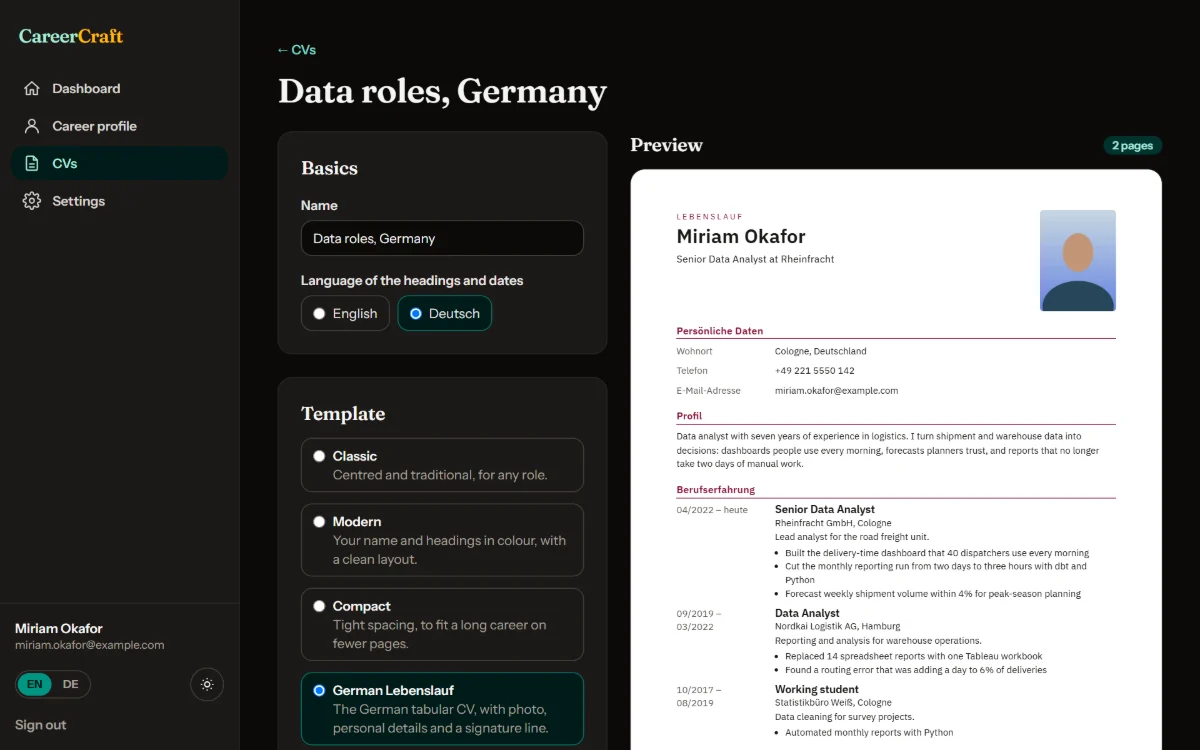
The CV builder with its live A4 preview 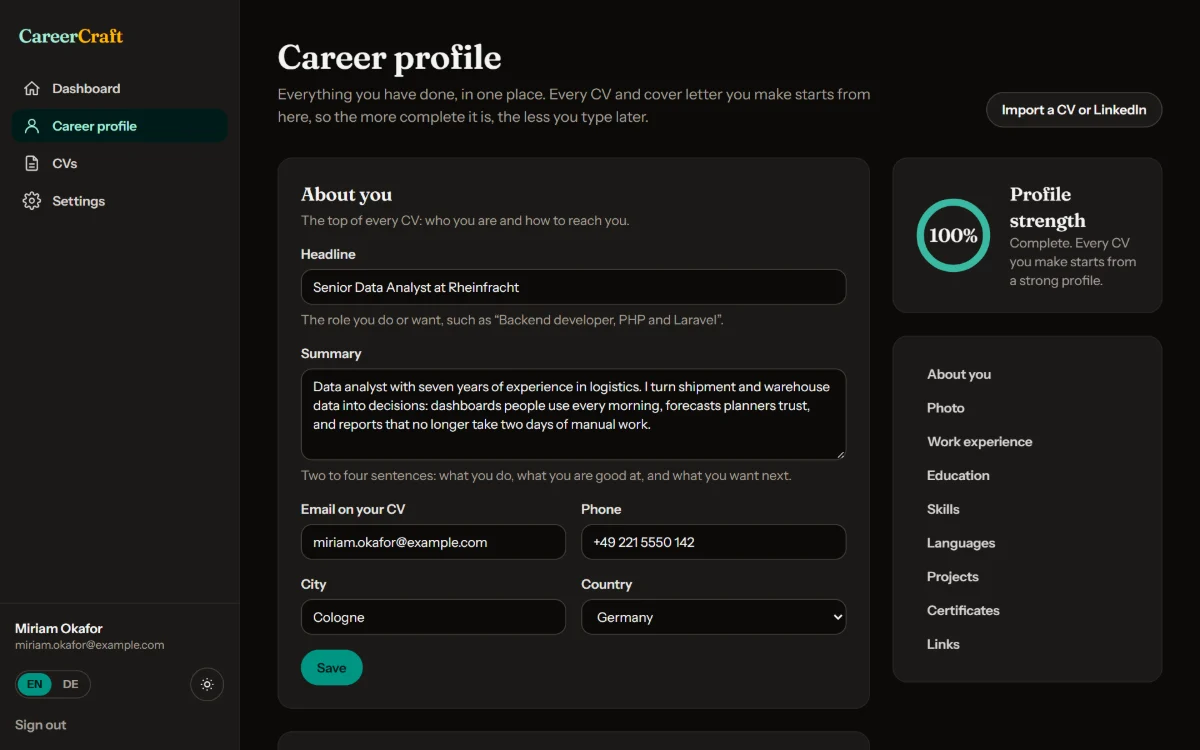
The career profile, with a strength score that lists what to add next 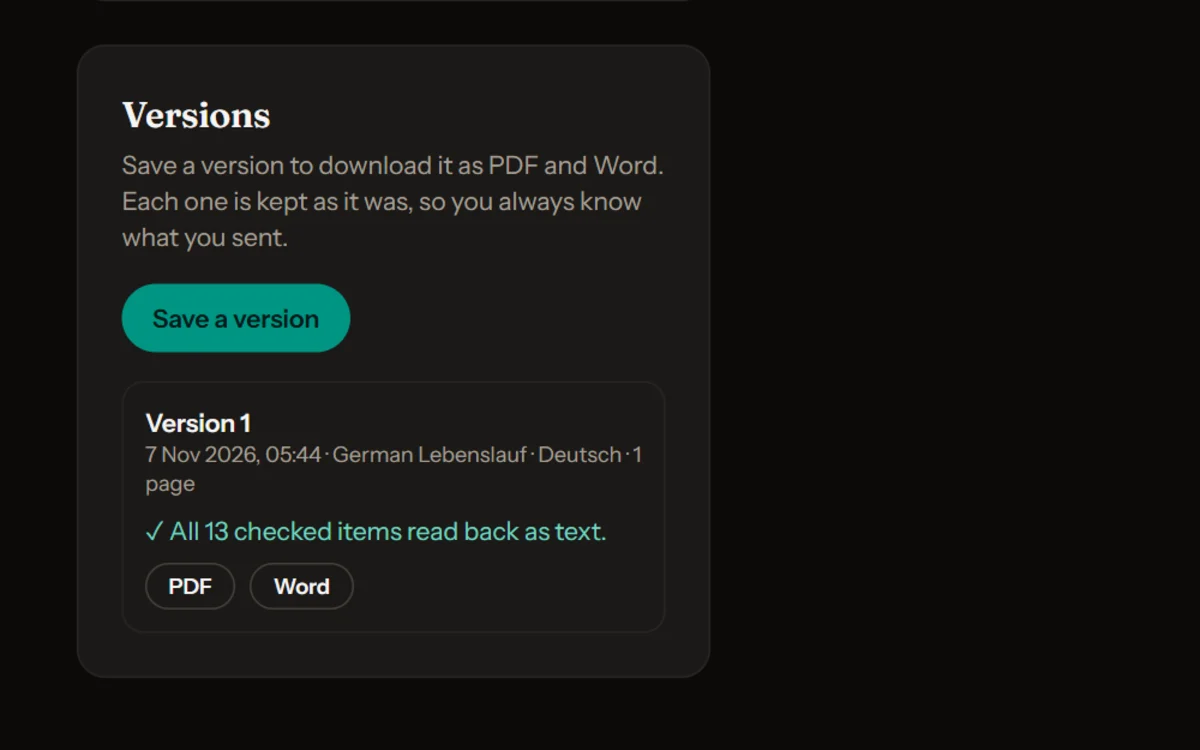
A saved version with its parser check 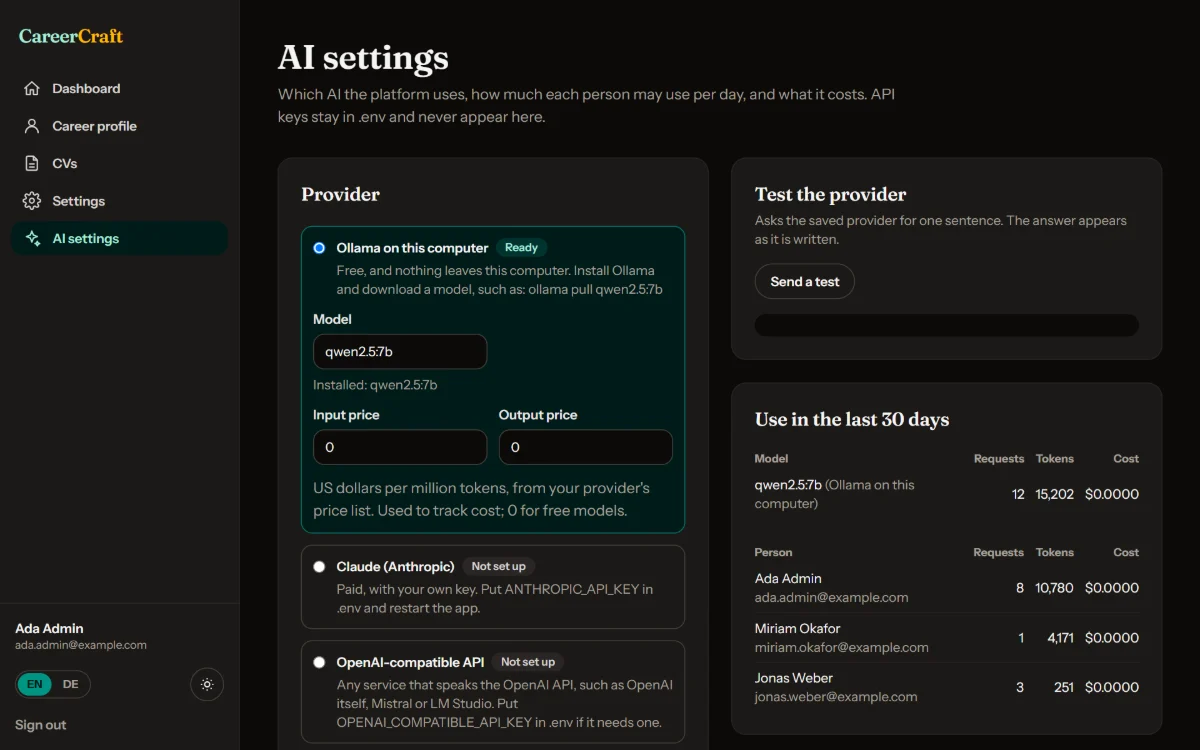
AI settings: provider, model, daily allowance and usage
Next case study
Enterprise Management System
Want to talk about a project like this?
Get in touch