Case study
Streaming Ad Platform
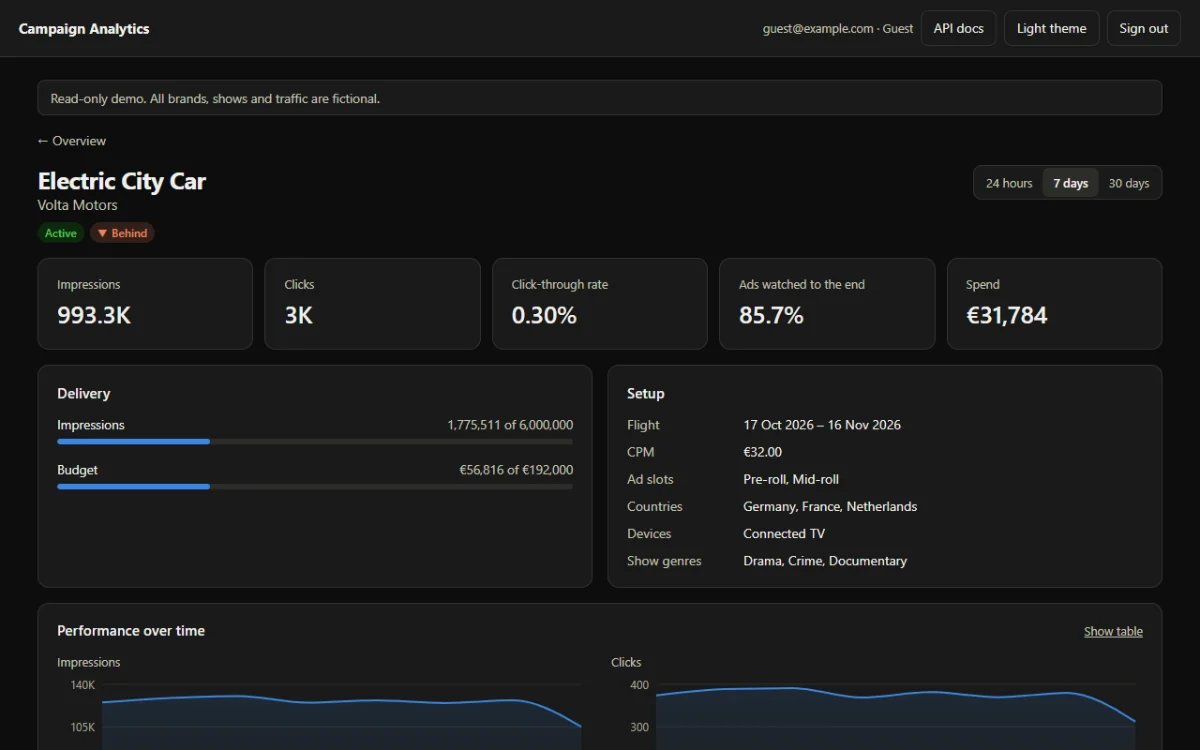
An ad platform for a streaming service: it picks the ad for every ad break, counts every view exactly once, and bills what was delivered.
- Role
- Sole developer
- Year
- 2026
- Source
- Public, MIT licence
- events per second in the load test, none lost or counted twice
- 10,000
- for a 90-day report over 9.9 million rows
- 0.5 s
- to count a campaign's unique viewers for a day
- 12 KB
- from a Redis outage to the alert email
- 97 s
01
Three parties, one ad break
Streaming services with an ad tier show short ads before, during and after episodes. The advertiser wants the ad seen by the right people for a set budget. The platform has to choose an ad for every break and keep each campaign on schedule. The viewer watches, and the player reports what happened.
I built the part in the middle, end to end: campaigns and teams, the ad decision, a real video player, event counting, analytics, billing and the operations around it. All brands, shows and traffic in the demo are fictional.
Stack
- Node.js
- TypeScript
- React
- PostgreSQL
- Redis
- Prisma
- Docker
- Grafana
- Playwright
02
What I built
Ad decisions
For each ad break the platform keeps the campaigns that match the dates, schedule, limits, country, device, slot, genre and audience. Guaranteed campaigns that are behind go first, and the rest is sold in a second-price auction. Any VAST 4.2 player can ask for an ad.
From upload to playback
A manager uploads a video, FFmpeg converts it in the background, an admin approves it, and the demo streaming site plays it before, during and after an episode.
Analytics and reports
Live charts, reach and frequency, drop-off, A/B tests that only name a winner at 95% confidence, and saved reports emailed as CSV and PDF.
Prepaid billing
A ledger that is never edited, holds for running budgets, invoices numbered with no gaps, EU VAT with VIES checks, currencies at the European Central Bank's daily rate and optional Stripe Checkout.
AI assistant
Optional and off by default. It answers questions such as why a campaign is behind, using read-only tools, and suggests changes that only apply once a person approves them. It runs on a free local model or a paid API.
Operations
Structured logs, metrics, traces and alerts in Grafana, and daily backups that are restored into a scratch database to prove they work.
03
How an event is counted
1
Player
- Plays the ad
- Reports each event with a unique ID
2
API
- A Redis script drops IDs already seen
- Queues the rest in the same atomic step
3
Worker
- Adds events into hourly totals
- Saves the totals and the queue entry's ID together
4
Dashboard
- One SQL query per view
- Live charts and reports
A retry can't count twice, and a crash can't lose or repeat an event.
04
The hard parts
01
Limits that hold when requests race
Budgets, goals and frequency caps are reserved in the same atomic Redis step that picks the ad, not checked afterwards. A campaign can't pass its goal, however many requests arrive at once.
02
Counting exactly once
An entry stays on the queue until its totals are saved, and its ID is saved in the same transaction. The load test included a worker crash, and no event was lost or counted twice.
03
Fast reports without a data warehouse
Events are added into one row per campaign, hour, show, slot, country and device, so the table grows with variety, not with traffic. Unique viewers are counted in HyperLogLog sketches.
05
Screens
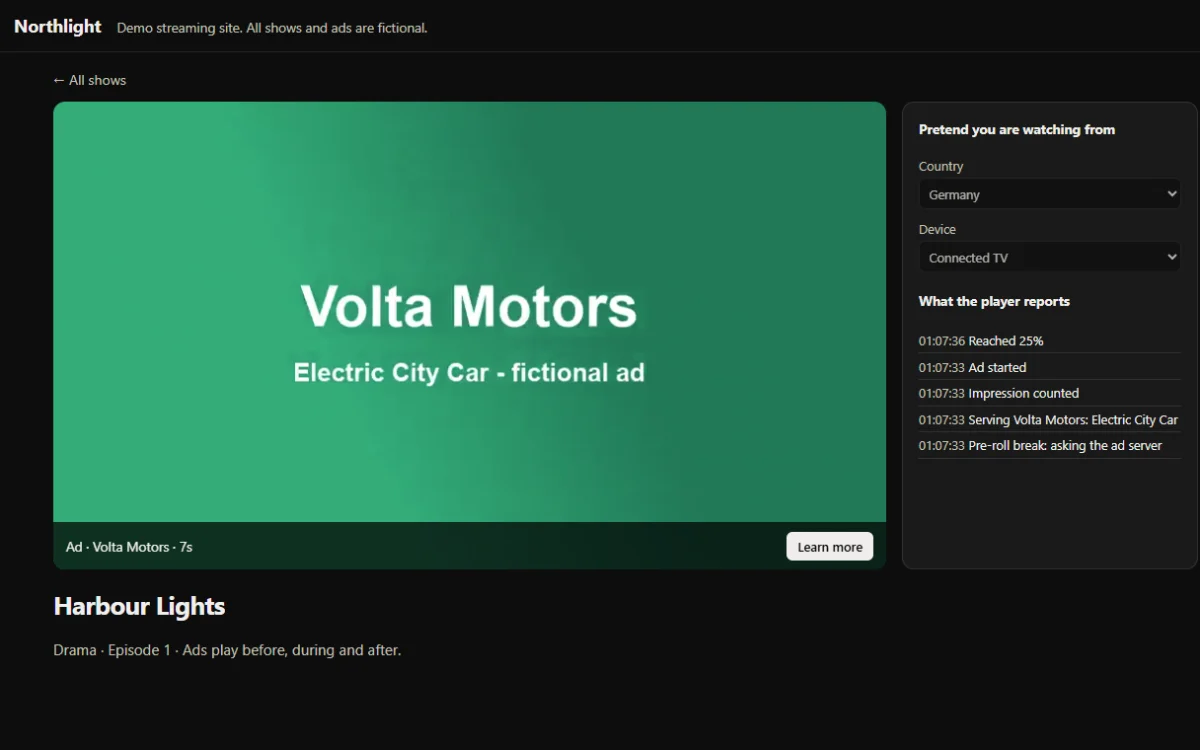
The demo streaming site playing an ad, with the events the player reports 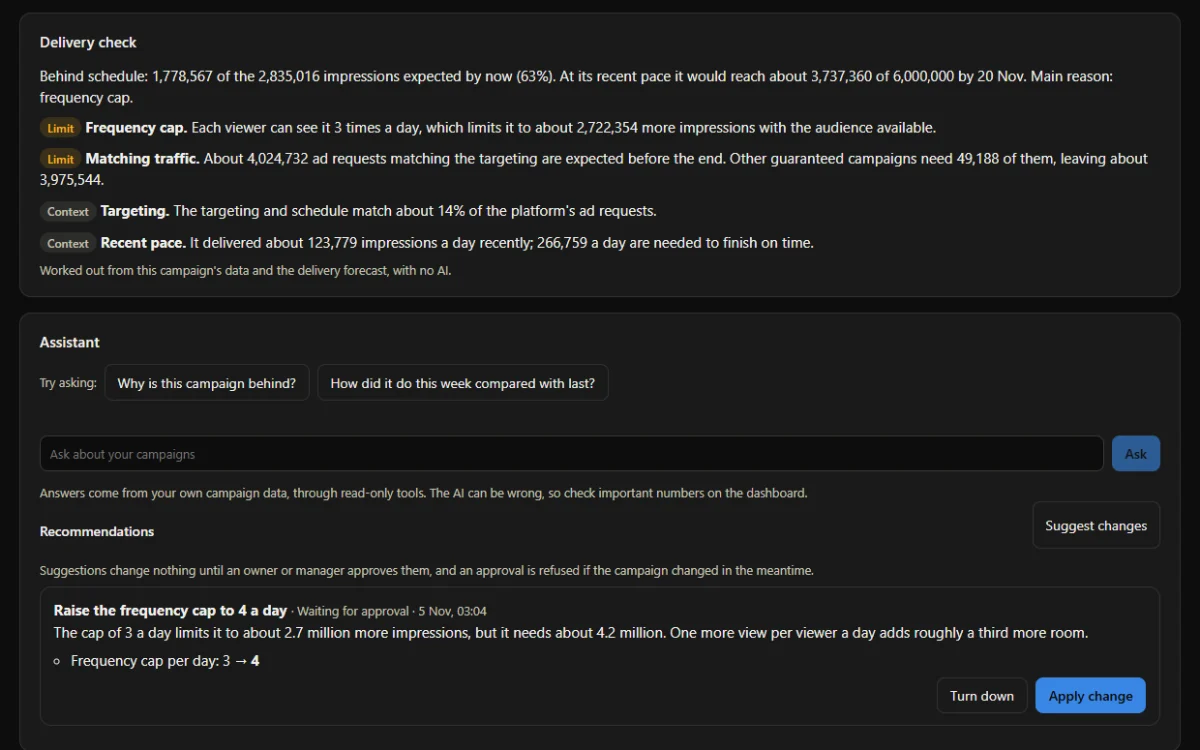
The delivery check explains why a campaign is behind, with no AI 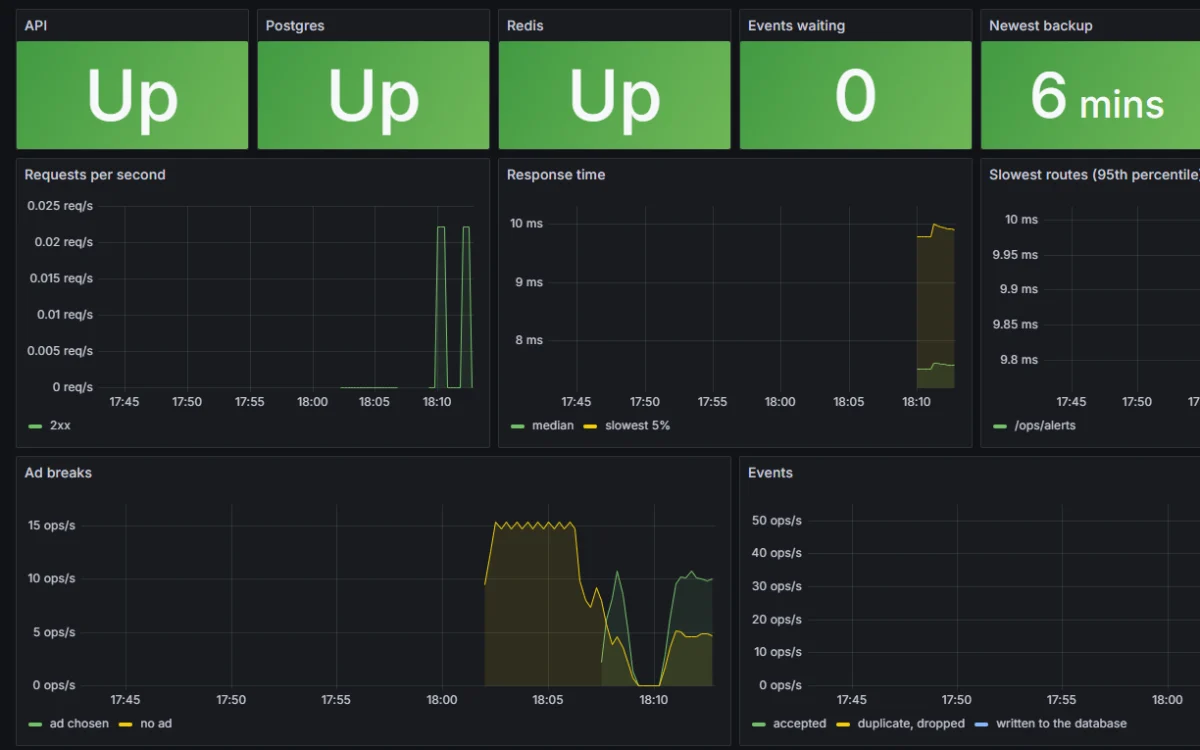
Platform health in Grafana, through a Redis outage and recovery 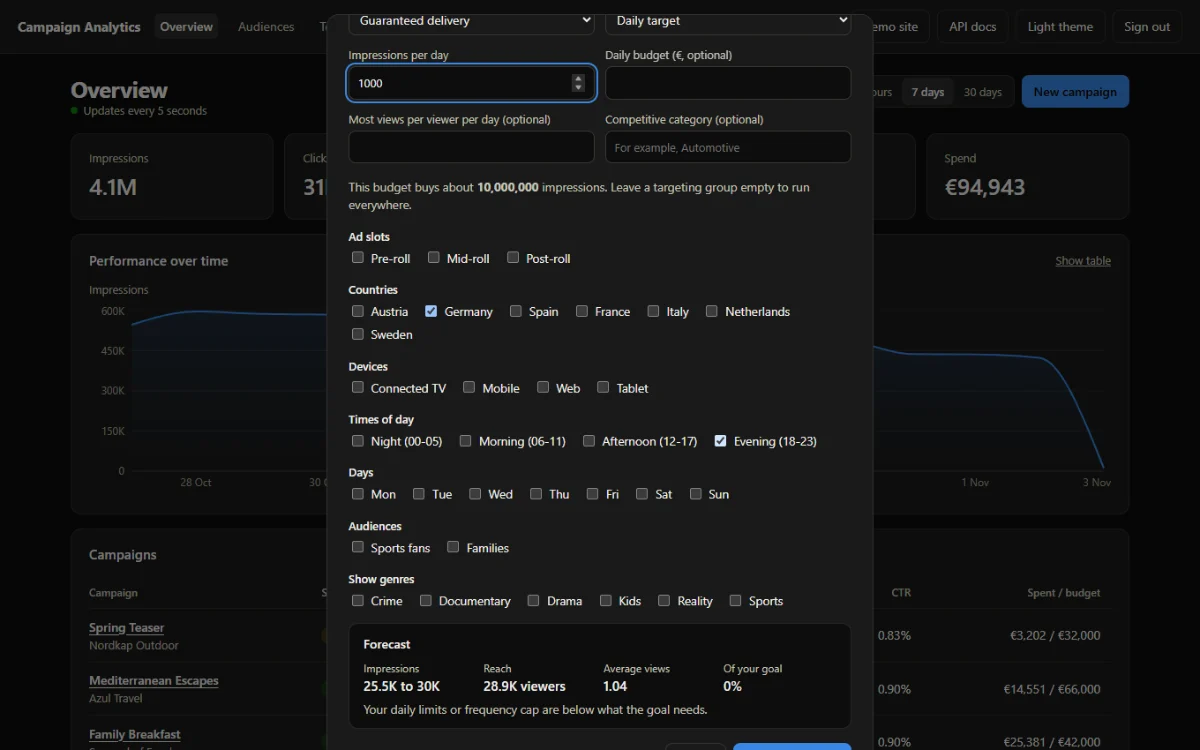
The campaign form with its live forecast
Next case study
CareerCraft
Want to talk about a project like this?
Get in touch